Showing posts with label art. Show all posts

Friday, October 23, 2009

Notes on Copyright for Artists (from the VAE BOBAA lecture series)

The lectures were awesome last night! The Visual Art Exchange really is a valuable resource for local artists, and I'm excited that I'm finally on their mailing list (if interested, you can sign up here).

As promised, notes from the talk by Anthony Biller, intellectual property lawyer, Coats & Bennett PLLC -
"Copyright Law for Artists"
  1. Copyright protects a particular way someone expresses themselves - it does not protect an idea or a process.

  2. A copyright transfers only through written agreement, except in work-for-hire situations.
    i.e. the only way a copyright leaves you is if you sign a paper saying so. Which means that freelance work is still copyright to the person who "made the expression" (the artist) and not the person who had the idea (the customer) unless you sign something that says otherwise.

  3. A copyright is not a monopoly right.
    If someone makes something identical to yours without having ever seen yours, then you both get copyrights on that. Copyright is not novel, just original to you.

  4. Don't copy.

  5. If you're asking "what is the percentage of the original I need to change to be legal" you're already starting down the wrong path.

  6. Aside from Fair Use, do everything you can to get permission from the original copyright holder.

  7. Copyright does not involve things that are common design elements or themes.

  8. If you created the design, act like the creator.

  9. Put copyright notices on your works. For example, paintings - write on the back "© #yourfullname #year" .

  10. Register your work with the Library of Congress.

  11. Fair Use is not an exception to copyright infringement, it is a legal copy.
    Be forewarned, there is a lot of ambiguity and subjectivity in precedence of Fair Use.

One of the problem he pointed out that whatever process you follow to make something Fair Use in a legal case, the entire thing will be decided by judge and jury. Which means you can't predict the outcome.

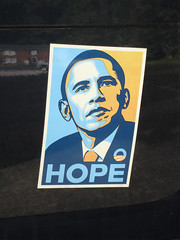
He also brought up the Shepard Fairey case, stating the he thought it was an obvious case of Fair Use, but "Mr. Fairey is not a perfect client" now.

I'll probably type up all of my notes and make them available next week, but those were his eleven primary talking points. ALSO! The VAE is going to make their notes available sometime in the coming weeks at http://www.visualartexchange.org/handouts.php (I'll be sure to alert you when it happens and post the link again).

Thursday, October 22, 2009

Copyright and Trademarks and Artists, oh my!

Obama Hope StickerShepard Fairey Sticker - it may be illegal for you to look at this picture

If you've been attempting to follow the many twists and turns of the Shepard Fairey case, you're probably wondering just as much as I am about copyright and trademarks in visual art.

I learned about this in college, but recently I've been thinking it could be imperative to brush up on current issues.

As a visual artist, my personal opinions are biased (grrrr, the extended copyright shenanigans of Disney). I tend to lean towards less extended copyrights, and more creative terms from businesses (like the USPS vs. Postal Service, wherein they got the right to use the Postal Service's songs in their commercials, and sell their CDs). I find today's legal copyright action against artists confusing compared to a variety of examples in art history where obvious sampling was applauded. Professionally, I want to make sure I avoid trouble.

Silkscreening (the technique Shepard Fairey's design uses/is based on) attracts copyright law trouble today like nobody's business. The technique involves direct transfers of photograph-like images, so the original artwork tends to be very recognizable.

Silkscreening started gaining popularity with the Pop Art movement - and the most famous works are of copyrighted images and products. Andy Warhol's did not get sued for his Coca-Cola and Campbell's Soup prints, they were direct copies of logos and branded materials, yet they sold for several thousands of dollars with no legal action. Lichtenstein sampled pages directly from DC and other comic books. No lawsuits there either.

Essentially, I'm not trying to start some sort of flame war, it comes down to these questions:
- Has copyright law changed substantially?
- Has the attitude of businesses towards artists changed?
- Has the public's attitude towards artist's rights changed?

Here's some articles of interest:
- From Warhol to Chuck D: Copyright Criminals at the Downtown Library
- Warhol is Turning in his Grave (article by Cory Doctorow)
- (Probably) Valid Fair Use Summary

SO - I'm going to Visual Art Exchange's "Business of Being an Artist" lecture series tonight. One of the topics is "Copyright Law for Artists" by an intellectual property lawyer. Interesting and topical! Hopefully I'll have some answers to these burning questions tomorrow.